


- Products
-

 Networking
- > AI Smart Managed Series
- > Industrial Ethernet
- Industrial PoE Media Converter
- Industrial Media Converter
- Industrial Unmanaged PoE Switch
- Industrial Managed PoE Switch
- Industrial Unmanaged Ethernet Switch
- Industrial Managed Ethernet Switch
- Industrial Serial Fiber Converter
- Industrial PoE Injector
- Industrial PoE Splitter
- Industrial PoE Extender
- Industrial Optical Switch
- Industrial PD Switch
- DIN-Rail Power Supply
- Rackmount DIN-Rail Bracket
- LED Screen Fiber Converter
- Industrial Ethernet Switch & 5G Router
- Industrial EOC Converter
- > Commercial Ethernet
-
 Video Transmission
-
 SFP Transceiver
-
 Other Fiber Optic & Networking Products
-
- Solutions
- News
- About
- Contact


1. Core features and value of industrial and commercial converters
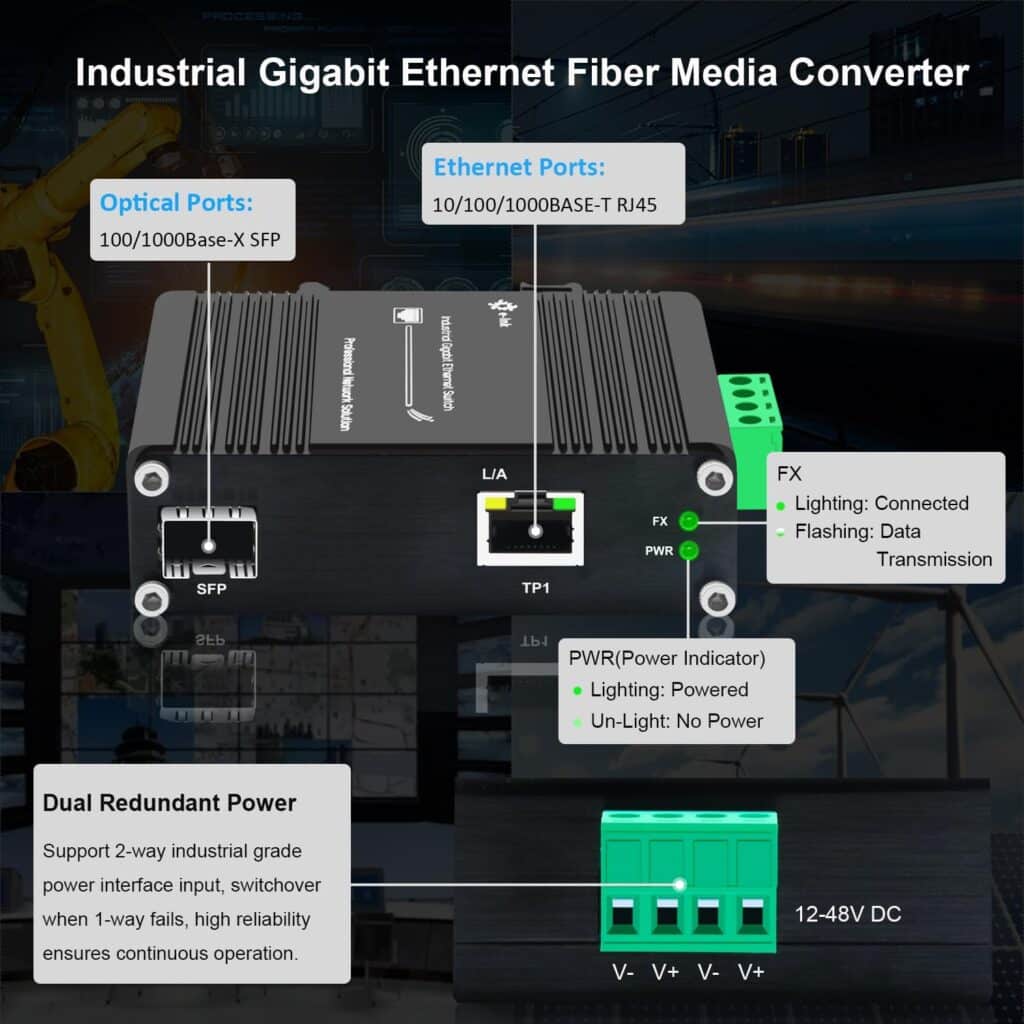
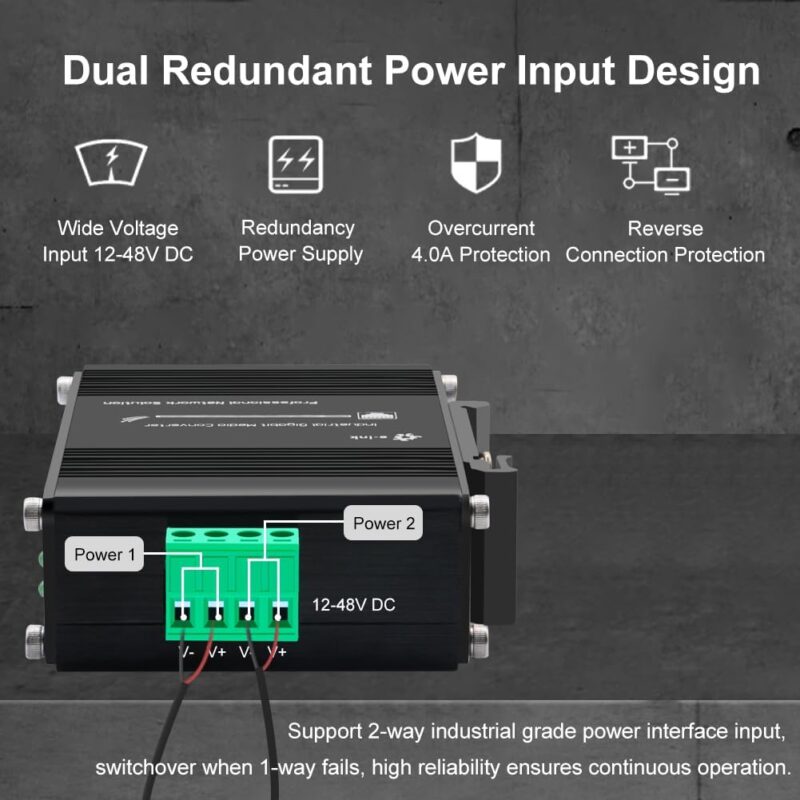
The design characteristics of industrial and commercial media converters have distinct focuses, and their importance is reflected in different networking requirements. Industrial is represented by LNK-IMC3012-SFP, with the core features being high reliability and strong environmental adaptability. It supports an extremely wide operating temperature range of -40°C to 75°C, has a wide voltage supply range of 12-48VDC, is compatible with unstable power supply environments in industrial sites, and also supports dual installation methods of DIN rail and wall mounting. Its MTBF exceeds 200,000 hours and complies with industrial anti-interference standards such as EN55022. The rich LED diagnostic indicators can quickly identify network faults. It is the core guarantee for stable network transmission in industrial scenarios.
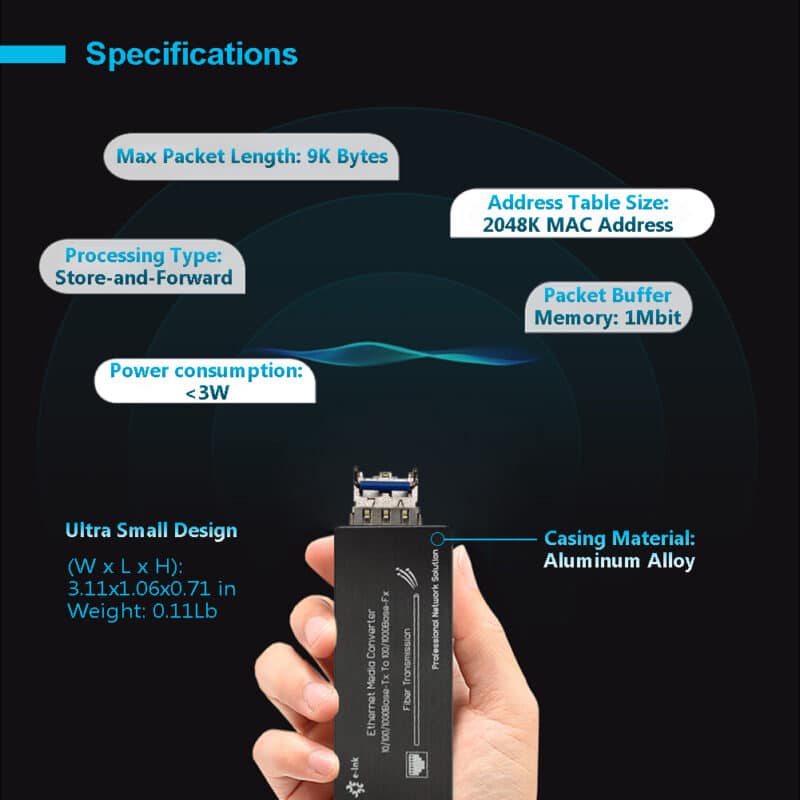
Commercial is centered around LNK-M3011-SFP, emphasizing ultimate portability and streamlined design. The entire device weighs only 46g and measures 78x27x18mm. It can be directly attached to the rear of a computer and supports dual power supply modes of USB/5-15VDC. The aluminum shell provides both cooling and lightweight practicality. Its MTBF reaches 100,000 hours and can meet the low-cost and easy-deployable fiber optic networking requirements of commercial scenarios.
2. Key Differences Between Industrial and Commercial converters
The key distinctions between the two lie in three core aspects: environmental adaptability, power supply installation, and reliability. In terms of the environment, industrial devices can withstand extreme temperature and humidity conditions, while commercial devices are only suitable for indoor environments with a constant temperature range of 0 to 45 degrees Celsius. In terms of power supply and installation, industrial devices use industrial wide-voltage terminals for power supply and follow industrial-standard installation methods, whereas commercial devices offer portable power supply and a design without fixed installation.
In terms of reliability, industrial devices undergo multiple industrial anti-interference certifications, ensuring long-term fault-free operation that far exceeds that of commercial devices. Moreover, they are equipped with professional diagnostic functions. Commercial devices, on the other hand, adopt a streamlined design to meet the routine usage requirements.
3. Scenario Adaptation of Industrial and Commercial Grade converters
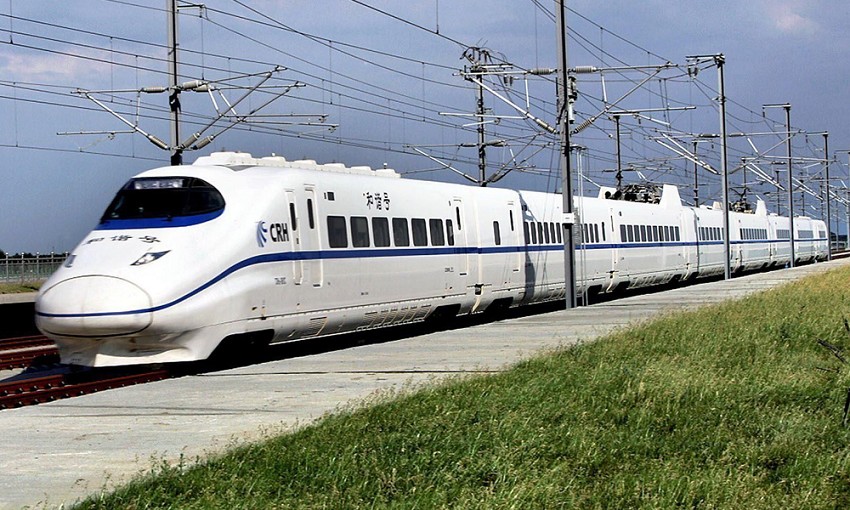
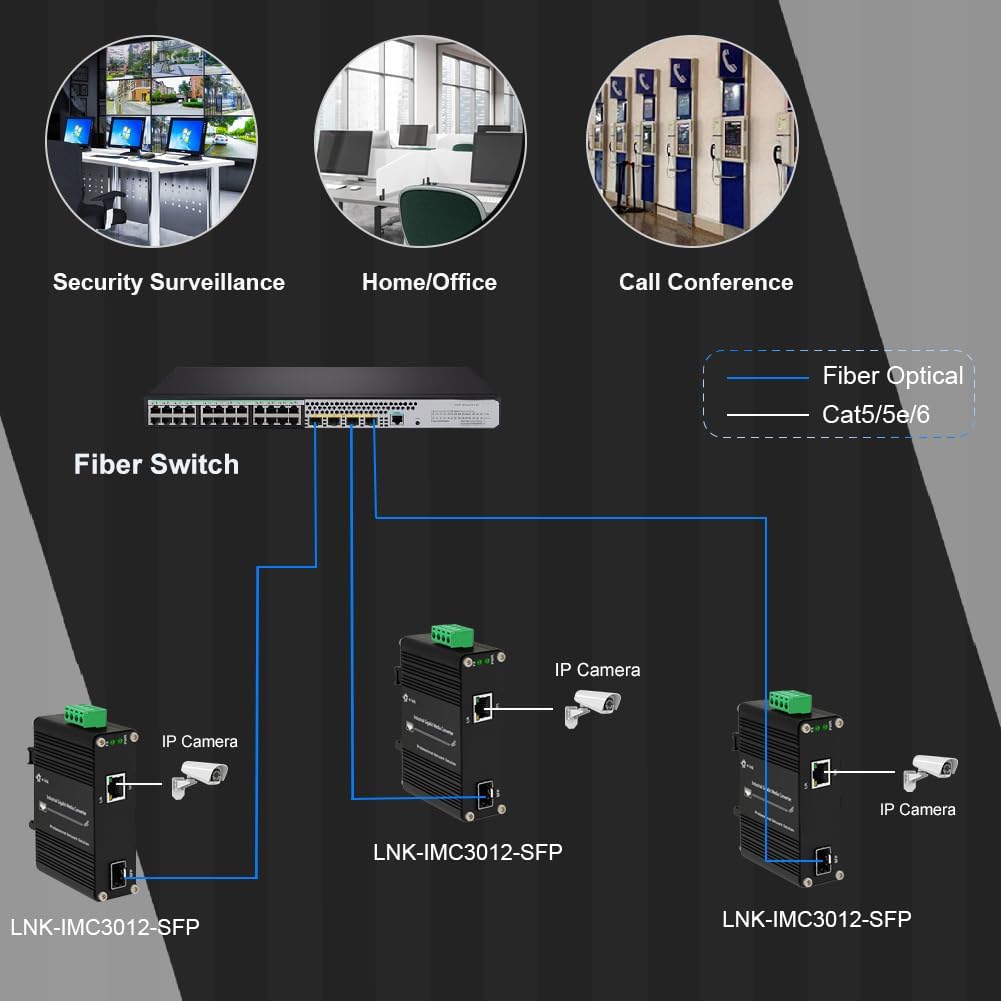
In terms of applicable scenarios, the boundaries between the two types of devices are clearly defined. The industrial LNK-IMC3012-SFP is suitable for industrial site networking, such as outdoor/enclosure deployments of industrial IP cameras and fiber switches, in harsh environments with electromagnetic interference and extreme temperatures, such as mines and traffic monitoring, and can meet the industrial transmission requirements of 550m/20km.
The commercial LNK-M3011-SFP is suitable for indoor commercial scenarios, such as fiber-to-laptop networking in office areas, desktop-level networking of small NVR/switches, and simple fiber expansion in small office environments, achieving low-cost and flexible optical-electrical conversion.
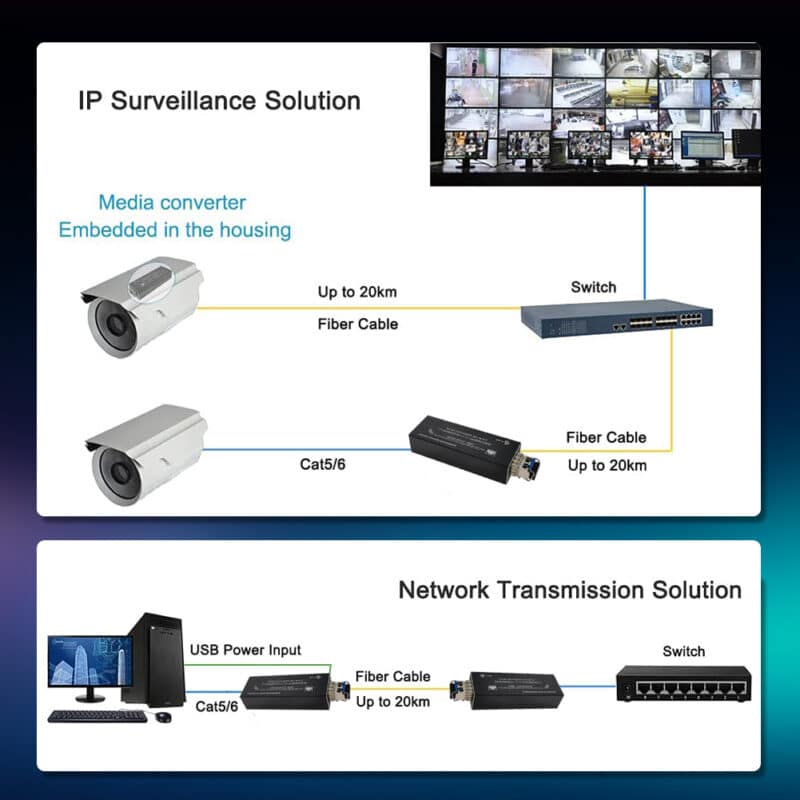
There is no superiority or inferiority between industrial and commercial media converters; they are differentiated based on different scenarios. The industrial version focuses on “stability and tolerance”, aiming to solve network transmission problems in harsh environments; the commercial version centers on “portability and efficiency”, meeting the low-cost requirements for indoor conventional networking.
The design and performance of the two e-link products precisely meet the networking demands of different scenarios, providing targeted solutions for various optical-electrical conversion applications in different industries.


